 An official website of the Pakistan government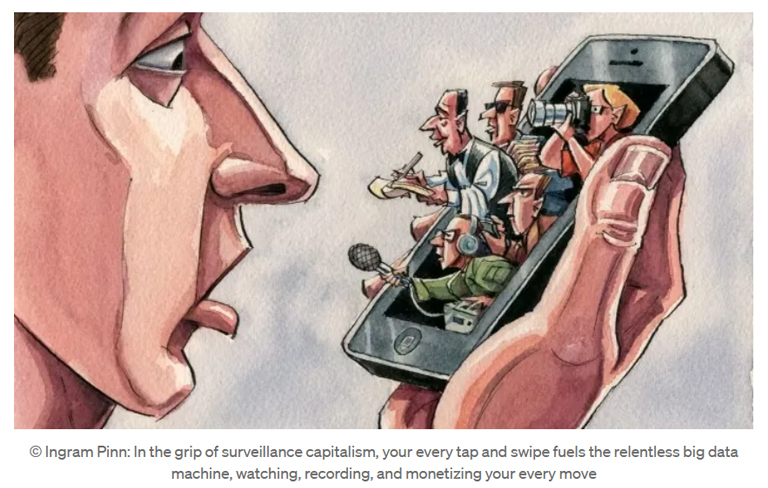
In the winding alleys of economic history, few paradigms have altered the fabric of society as profoundly as capitalism. From the Industrial Revolution’s mechanization to the digital era’s information surge, capitalism has consistently pursued the commodification of every conceivable resource. However, as we navigate the complexities of the 21st century, a more insidious form has emerged — Surveillance Capitalism. Coined by Shoshana Zuboff, this term encapsulates a disturbing shift from the commodification of physical goods to the commodification of human experience itself. Through the lens of surveillance, our most intimate behaviors, thoughts, and emotions have become the raw materials driving a new economy, operating largely in the shadows.
Shoshana Zuboff, in her seminal work The Age of Surveillance Capitalism, argues that this new form of capitalism represents a profound shift in power dynamics. While traditional capitalism was constrained by the physical limits of production and consumption, surveillance capitalism operates in the boundless domain of the digital. It’s a system that thrives on ubiquity, embedding itself in every aspect of our lives, often without our knowledge or consent.
The ethical implications of this shift are staggering. In traditional capitalism, exploitation was often visible — sweatshops, environmental degradation, and income inequality were tangible consequences of the system. Surveillance capitalism, however, operates in the shadows. For instance, a 2021 study found that 72% of apps share your data with third-party companies without your explicit consent, exposing how deeply embedded this exploitation is in our daily lives. It’s a form of control that operates invisibly, shaping our thoughts and actions from behind the scenes.
Evgeny Morozov, a prominent technology critic, has long argued that the internet, far from being a liberating force, has become a tool of surveillance and control. In his book The Net Delusion, Morozov exposes the dark side of Internet freedom, showing how governments and corporations alike use digital technologies to monitor and manipulate citizens. His work serves as a stark reminder that the tools of surveillance capitalism are not neutral — they are designed to serve the interests of those in power.
Zeynep Tufekci, in Twitter and Tear Gas, examines how social media platforms, while offering new avenues for protest and resistance, also enable unprecedented levels of surveillance. Tufekci’s work highlights the double-edged nature of these technologies — while they can empower individuals, they also expose us to new forms of control and manipulation. A striking example is the use of social media data to monitor and suppress protests, as seen during the Arab Spring and Hong Kong protests.
Frank Pasquale, in The Black Box Society, delves into the opaque algorithms that govern our lives. He argues that these algorithms, controlled by a handful of corporations, operate as black boxes — inscrutable systems that make decisions about us without our knowledge or input. Pasquale’s work raises critical questions about accountability and transparency in the age of surveillance capitalism. For instance, the controversy surrounding TikTok’s algorithm, accused of promoting harmful content to vulnerable users, underscores the dangers of these opaque systems.
However, the integration of AI and ML into surveillance capitalism raises new ethical dilemmas. These systems are often designed to optimize efficiency and profit, with little regard for the broader social or ethical implications. They can perpetuate biases, amplify inequalities, and undermine autonomy. A 2018 study revealed that AI systems used in hiring processes discriminated against female applicants, demonstrating how these technologies can entrench existing biases.
In The Age of Surveillance Capitalism, Zuboff warns that this trajectory represents a fundamental threat to democracy and human freedom. It’s a system that prioritizes profit over people, efficiency over ethics, and control over autonomy. As we move deeper into the digital age, the challenge will be to ensure that these technologies serve to enhance rather than diminish our humanity.
In parallel, promoting digital literacy is essential to empower individuals with the knowledge to make informed choices about the technologies they engage with. Public awareness campaigns and educational programs should focus on demystifying the mechanisms of surveillance capitalism.
Technological innovation can also play a key role in reclaiming agency and autonomy. Privacy-focused tools, such as encrypted messaging services and decentralized platforms, offer alternatives to the dominant surveillance-based models. The ethical development of AI and machine learning is equally important, ensuring that these technologies are designed with transparency and fairness in mind. Additionally, fostering corporate responsibility and advocating for ethical business practices can drive change from within the industry.
Finally, civic engagement and activism are vital in challenging the dominance of surveillance capitalism and pushing for a digital future that upholds human dignity and freedom. By adopting this multifaceted approach, society can work towards a more equitable and autonomous digital age.
The Exploitative Neo-Mechanics of Surveillance Capitalism
At the core of surveillance capitalism lies a radical transformation: the conversion of human experience into data. Tech giants like Google, Meta, and Amazon have perfected the art of extracting, analyzing, and exploiting this data to predict and, increasingly, to influence behavior. In this new era, “Big Brother” is no longer a distant concept of government oversight but a corporate force siphoning the lifeblood of our digital existence. This new form of capitalism is defined by four key characteristics:- Data Extraction: Surveillance capitalism thrives on the relentless collection of personal data. Whether through our online interactions, search queries, location tracking or even biometric information, this data is continuously harvested — often without our explicit consent. A staggering example: by 2023, Google processed over 3.5 billion searches per day, each interaction feeding into its vast data ecosystems. This data is not merely collected but commodified, treated as a raw material to be mined for insights and sold to the highest bidder.
- Behavioral Prediction: The true value of this data lies in its predictive power. Advanced algorithms sift through vast information to forecast our future actions, preferences, and desires. These predictions are highly sought-after commodities, sold to advertisers, political campaigns, and other entities eager to influence behavior. For instance, Cambridge Analytica’s misuse of Facebook data to influence the 2016 U.S. presidential election starkly illustrates how predictive analytics can be weaponized.
- Behavioral Modification: Beyond mere prediction, surveillance capitalism seeks to modify our behavior. By subtly nudging us towards certain actions — whether it’s making a purchase, voting for a candidate, or spending more time on a platform — these systems shape our decisions to serve corporate interests. It’s estimated that by 2024, global digital advertising spending will exceed $600 billion, much of it directed by algorithms designed to not just understand us, but to change us.
- Market Dynamics: Unlike traditional capitalism, where goods and services are the primary commodities, surveillance capitalism revolves around the production of predictive data products. This new market is built on the extraction of value from human experience, raising profound ethical questions about autonomy, consent, and the very nature of freedom. With an estimated 12½ trillion hours spent online in 2022, the scale of human experience being commodified is unprecedented.
Surveillance Capitalism vs. Traditional Capitalism
To grasp the significance of surveillance capitalism, it’s essential to draw comparisons with its predecessor. Traditional capitalism exploited natural resources, labor, and capital to drive economic growth. In contrast, surveillance capitalism exploits the human experience. It transforms our thoughts, behaviors, and emotions into commodities, reducing the richness of human life to mere data points in a vast computational network.Shoshana Zuboff, in her seminal work The Age of Surveillance Capitalism, argues that this new form of capitalism represents a profound shift in power dynamics. While traditional capitalism was constrained by the physical limits of production and consumption, surveillance capitalism operates in the boundless domain of the digital. It’s a system that thrives on ubiquity, embedding itself in every aspect of our lives, often without our knowledge or consent.
The ethical implications of this shift are staggering. In traditional capitalism, exploitation was often visible — sweatshops, environmental degradation, and income inequality were tangible consequences of the system. Surveillance capitalism, however, operates in the shadows. For instance, a 2021 study found that 72% of apps share your data with third-party companies without your explicit consent, exposing how deeply embedded this exploitation is in our daily lives. It’s a form of control that operates invisibly, shaping our thoughts and actions from behind the scenes.
Theoretical Foundations and Ethical Dilemmas
Surveillance capitalism did not emerge in a vacuum. It builds on decades of technological advancement and philosophical thought. Scholars like Evgeny Morozov, Zeynep Tufekci, and Frank Pasquale have all contributed to the discourse, warning of the dangers that lie ahead.Evgeny Morozov, a prominent technology critic, has long argued that the internet, far from being a liberating force, has become a tool of surveillance and control. In his book The Net Delusion, Morozov exposes the dark side of Internet freedom, showing how governments and corporations alike use digital technologies to monitor and manipulate citizens. His work serves as a stark reminder that the tools of surveillance capitalism are not neutral — they are designed to serve the interests of those in power.
Zeynep Tufekci, in Twitter and Tear Gas, examines how social media platforms, while offering new avenues for protest and resistance, also enable unprecedented levels of surveillance. Tufekci’s work highlights the double-edged nature of these technologies — while they can empower individuals, they also expose us to new forms of control and manipulation. A striking example is the use of social media data to monitor and suppress protests, as seen during the Arab Spring and Hong Kong protests.
Frank Pasquale, in The Black Box Society, delves into the opaque algorithms that govern our lives. He argues that these algorithms, controlled by a handful of corporations, operate as black boxes — inscrutable systems that make decisions about us without our knowledge or input. Pasquale’s work raises critical questions about accountability and transparency in the age of surveillance capitalism. For instance, the controversy surrounding TikTok’s algorithm, accused of promoting harmful content to vulnerable users, underscores the dangers of these opaque systems.
The Hideous Alliance of AI, Machine Learning & Digital Surveillance
The rise of Artificial Intelligence (AI) and Machine Learning (ML) has only intensified the power of surveillance capitalism. These technologies enable the collection, analysis, and exploitation of data on an unprecedented scale. AI and ML can process vast amounts of information, identifying patterns and correlations that would be impossible for humans to detect. This capability has given tech giants an even greater ability to predict and influence behavior. The “Big Brother” of today is a predictive engine, tailoring every online moment to guide, influence, and direct your future decisions.However, the integration of AI and ML into surveillance capitalism raises new ethical dilemmas. These systems are often designed to optimize efficiency and profit, with little regard for the broader social or ethical implications. They can perpetuate biases, amplify inequalities, and undermine autonomy. A 2018 study revealed that AI systems used in hiring processes discriminated against female applicants, demonstrating how these technologies can entrench existing biases.
In The Age of Surveillance Capitalism, Zuboff warns that this trajectory represents a fundamental threat to democracy and human freedom. It’s a system that prioritizes profit over people, efficiency over ethics, and control over autonomy. As we move deeper into the digital age, the challenge will be to ensure that these technologies serve to enhance rather than diminish our humanity.
Societal Implications
The societal implications of surveillance capitalism are profound. This new economic order not only commodifies human experience but also reshapes the social fabric in ways that are often imperceptible. It erodes the boundaries between the public and private, leaving individuals exposed to manipulation and control by entities that prioritize profit above all else. A Pew Research study found that 79% of Americans are concerned about how companies are using their data, reflecting a growing awareness and unease with this new economic order.Reclaiming Human Agency, Autonomy, and Privacy
Addressing the challenges of surveillance capitalism requires a comprehensive approach that combines regulation, education, technology, and civic engagement. Strengthening regulatory frameworks is crucial, with governments and international bodies developing robust laws that protect individuals’ privacy and ensure transparency in how data is collected, used, and monetized. The European Union’s General Data Protection Regulation (GDPR) serves as a significant step in this direction, providing a framework for data protection that has influenced global standards.In parallel, promoting digital literacy is essential to empower individuals with the knowledge to make informed choices about the technologies they engage with. Public awareness campaigns and educational programs should focus on demystifying the mechanisms of surveillance capitalism.
Technological innovation can also play a key role in reclaiming agency and autonomy. Privacy-focused tools, such as encrypted messaging services and decentralized platforms, offer alternatives to the dominant surveillance-based models. The ethical development of AI and machine learning is equally important, ensuring that these technologies are designed with transparency and fairness in mind. Additionally, fostering corporate responsibility and advocating for ethical business practices can drive change from within the industry.
Finally, civic engagement and activism are vital in challenging the dominance of surveillance capitalism and pushing for a digital future that upholds human dignity and freedom. By adopting this multifaceted approach, society can work towards a more equitable and autonomous digital age.
Stay ahead of the curve! Follow National CERT on website and social media platforms—Twitter, Facebook, LinkedIn, and Instagram—for real-time updates on the latest trends in the realm of cybersecurity. Don’t miss out on crucial insights that can fortify your defenses against evolving cyber threats.
This blog is part of a technology based community blog series called CyberTech Chronicles under the National’ CERT’s ABC Program, aimed at fostering a vibrant community of technology enthusiasts. Through insightful reflections and shared experiences, this blog series provides valuable perspectives on navigating the complexities of IT and cybersecurity landscapes.
 Qazi Mohammad Shayan works at the National Cyber Emergency Response Team (nCERT). He holds a Bachelor's in International Relations and is currently pursuing an MPhil in Governance and Public Policy. His interests include literature, philosophy, public policy and contemporary socio-ethical issues, particularly those related to technology's societal impact.
Qazi Mohammad Shayan works at the National Cyber Emergency Response Team (nCERT). He holds a Bachelor's in International Relations and is currently pursuing an MPhil in Governance and Public Policy. His interests include literature, philosophy, public policy and contemporary socio-ethical issues, particularly those related to technology's societal impact.