 An official website of the Pakistan government
A country's progress mainly depends on the quality of its education system, which determines the direction of growth and prosperity. However, due to a combination of sociocultural factors and individual differences in IQ, students' learning capacities vary widely. The achievement of universal access to high-quality education is seriously hampered by this discrepancy, particularly in developing countries with little funding. By addressing these issues and realizing each learner's potential, artificial intelligence promises to revolutionize the education system with a transformative opportunity. Artificial intelligence (AI) has undergone substantial development since its early investigations in the mid-1900s through the idea of replicating human intelligence with machines. Advances in AI have led to revolutionary breakthroughs in a range of fields, including education, from early symbolic reasoning to sophisticated machine learning.
In today's quickly evolving world of technology, AI is not a sci-fi notion in the classroom. It presents the possibility of more equitable student accomplishment recognition, more individualized support, and improved relationships between students and teachers. However, its efficiency mainly depends on the way of adoption, guaranteeing that every student has fair access to high-quality education.
The Education 4.0 Framework, created by the World Economic Forum in 2020, lists eight essential changes that must be made to improve the quality of education in this new era. We can hasten the adoption of Education 4.0 by utilizing AI, the defining technology of the Fourth Industrial Revolution, to prepare students for success in an innovative and intelligent systems-driven future.
With its innovative approaches to student engagement, enhanced learning outcomes, and increased accessibility and equity in education, AI is revolutionizing the global educational landscape. AI has the ability to foster in students a sense of curiosity, critical thinking, and creativity through personalized learning experiences. Modern technology can help teachers overcome resource limitations, close quality gaps, and provide students with a more engaging learning environment.
The potential of artificial intelligence to deliver individualized learning experiences is among its most important contributions. AI systems examine how students learn and modify the curriculum to suit each student's needs. This guarantees that learners can advance at their own pace, better understanding difficult ideas with their individual learning preferences. This personalized approach fosters a more inclusive learning environment by not only pushing the advanced learners but also assisting struggling students in catching up. AI-powered interactive lessons can also improve the comprehension and interest level of the content. Through various games, simulations, and virtual tutors, students can delve deeper and examine topics from a variety of perspectives. AI tools, for example, can transform abstract scientific or mathematical ideas into interactive models, allowing students to explore and visualize concepts that would otherwise be intimidating in conventional classroom settings.
Artificial Intelligence provides teachers with additional tools to improve their teaching methods. AI allows teachers to concentrate more on teacher-student engagement by automating repetitive tasks like attendance tracking, grading, and even creating customized assignments. AI-powered tools can help instructors plan lessons as AI systems can gauge students' levels of engagement, confusion, or frustration by examining their facial expressions and emotions throughout lessons. With the help of this real-time feedback, teachers can modify their lesson plans as needed to keep students interested and ensure that concepts are explained clearly. Both teachers and students can gain from more dynamic and responsive teaching methods which are data-based.
One of the best examples of how AI is transforming education is Squirrel AI, a Chinese company that uses AI to power education. By levelling the playing field for students from different backgrounds and addressing the lack of individualised attention in traditional classrooms, the platform benefits students. One noteworthy success story involved a 13-year-old student who, in just one semester, increased their math test scores from 50% to 62.5% with the help of Squirrel AI's tutoring support. Two years later, the student achieved 85% on their final middle school exams. AI systems that teach Chinese characters using computer vision and speech synthesis are beneficial even for first graders.
Pakistan, with about 23 million children out of school, has various issues with education, such as a lack of trained teachers, a high student dropout rate, poor infrastructure, and a widening digital divide. According to UNESCO, to meet its educational targets by 2030, Pakistan must significantly increase its no of teachers. The current educational system is under tremendous strain as a result of this shortage. The problem has been worsened by the administrative load that current teachers bear, which leaves little time for individualized student engagement.
Moreover, a major obstacle to effectively utilizing AI in Pakistan is the lack of digital skills in the country. AI has the potential to revolutionize education, but a lot of people lack even the most basic digital literacy. AI may be able to provide the creative solutions needed to address these problems.
In developing countries like Pakistan, AI has the potential to provide high-quality, scalable, and reasonably priced learning resources, thereby addressing major issues in the education system. Artificial Intelligence can fill in the gaps left by a lack of infrastructure, shortage of teachers, and limited resources by providing innovative learning experiences. By using AI even those who live in far-flung areas like Balochistan can get a top-notch education that meets all international standards. This strategy encourages greater educational equity among all the provinces of Pakistan while assisting in the mitigation of disparities. By providing adaptable, AI-powered learning environment, people can meet their professional or academic objectives whenever it's most convenient for them. This helps students take advantage of more opportunities and contributes to the development of society as a whole by producing a workforce that is more knowledgeable and competitive in the global economy.
The COVID-19 pandemic and other recent international events have accelerated the use of AI in the education sector. Because of lockdowns and other disruptions during the pandemic, educational institutions around the world—including those in Pakistan—faced difficulties which they never heard of. This sped up the transition to digital education, with AI emerging as a key tool for improving and transforming the educational environment.
A noteworthy initiative is "The City School Group," which collaborated with "Century" to ensure that instruction continued unhindered throughout the lockdown. By utilizing artificial intelligence, this partnership was able to minimise the disruptions caused by the pandemic by guaranteeing that students always had access to educational resources. For students, this meant information which is always available, and for teachers, it meant AI tools that made lecture preparation easier and content delivery clearer. Students' academic performance improved as a result of this initiative, which also raised the quality of education.
Apart from its immediate use in the pandemic, several eminent universities in Pakistan are proactively integrating artificial intelligence into their academic programs to make students capable of proficiencies pertinent to the contemporary digital landscape. University of Engineering and Technology (UET) lahore, for example, has launched a master's program in artificial intelligence. Similarly, the National University of Sciences & Technology (NUST) trains students for professions in cutting-edge technology by providing undergraduate and graduate degrees in machine learning and natural language processing.
AI-related courses and programs have also been introduced by other organisations, including the Commission on Science and Technology for Sustainable Development in the South (COMSATS) and the Lahore University of Management Sciences (LUMS). These programs seek to give students the know-how and abilities needed to prosper in a quickly changing technological environment, highlighting AI's revolutionary influence on Pakistani education.
One of the several major obstacles is data privacy and cybersecurity since security lapses could compromise the system as a whole, necessitating the implementation of strong security protocols. For example, as per recent reports data breaches in Pakistan have risen by 35% over the past year, highlighting the need for enhanced cybersecurity measures. Firewall was made to protect that but instead, it restricts access to worldwide AI tools and resources and impedes the use and efficacy of AI in education.
Low literacy rates are also problematic, especially in rural areas. Pakistan has a 60% literacy rate, with notable differences between the country's urban and rural areas. The situation is even worse in rural areas, where educational opportunities are scarcer. Another issue is resistance to change, as many educational institutions and teachers are hesitant to implement new technologies out of concern for their jobs and traditional teaching methods.
Economic constraints are also a major issue as an AI system’s implementation and maintenance can be prohibitively expensive, particularly for educational institutions with limited funding. Pakistan spends less than 2% of its GDP on education, which reduces the amount of funds available for the development and upkeep of AI systems. It's possible that current AI tools don't fully satisfy regional demands or aren't designed for a variety of educational environments. Inadequate knowledge and instruction among teachers, policymakers, and students impede efficient utilization even more. For example, a recent UNESCO report states that just 22% of Pakistani teachers have received formal training in digital literacy – now imagine the situation.
About 43% of rural areas lack dependable internet access, making infrastructure constraints like poor internet connectivity a problem. Another layer of complexity is added by institutional and political resistance, which includes elite capture and a lack of political will.
A complex landscape of opportunities and challenges surrounds the integration of artificial intelligence into Pakistan's educational system. Although AI has the potential to revolutionize education by providing tailored learning experiences, improving teacher effectiveness, and increasing access to high-quality education, there are a number of important obstacles that need to be overcome. Critical barriers to the successful application of AI include low literacy rates, stringent firewall laws, and enduring concerns about cybersecurity and data privacy. Further impeding progress are economic limitations, insufficient infrastructure, and resistance to technological change.
Given the increasing number of data breaches and Pakistan's limited internet freedom, it is clear that strong cybersecurity measures are required. In a similar vein, addressing the differences in education between urban and rural areas, enhancing teachers' technological proficiency, and guaranteeing free access. To overcome these obstacles, financial commitments, focused training, and infrastructure advancements will be essential.
Despite these challenges, AI has enormous potential to transform Pakistan’s education system. When used carefully, AI can improve learning outcomes, close educational gaps, and advance the long-term development of the country.
In today's quickly evolving world of technology, AI is not a sci-fi notion in the classroom. It presents the possibility of more equitable student accomplishment recognition, more individualized support, and improved relationships between students and teachers. However, its efficiency mainly depends on the way of adoption, guaranteeing that every student has fair access to high-quality education.
The Education 4.0 Framework, created by the World Economic Forum in 2020, lists eight essential changes that must be made to improve the quality of education in this new era. We can hasten the adoption of Education 4.0 by utilizing AI, the defining technology of the Fourth Industrial Revolution, to prepare students for success in an innovative and intelligent systems-driven future.
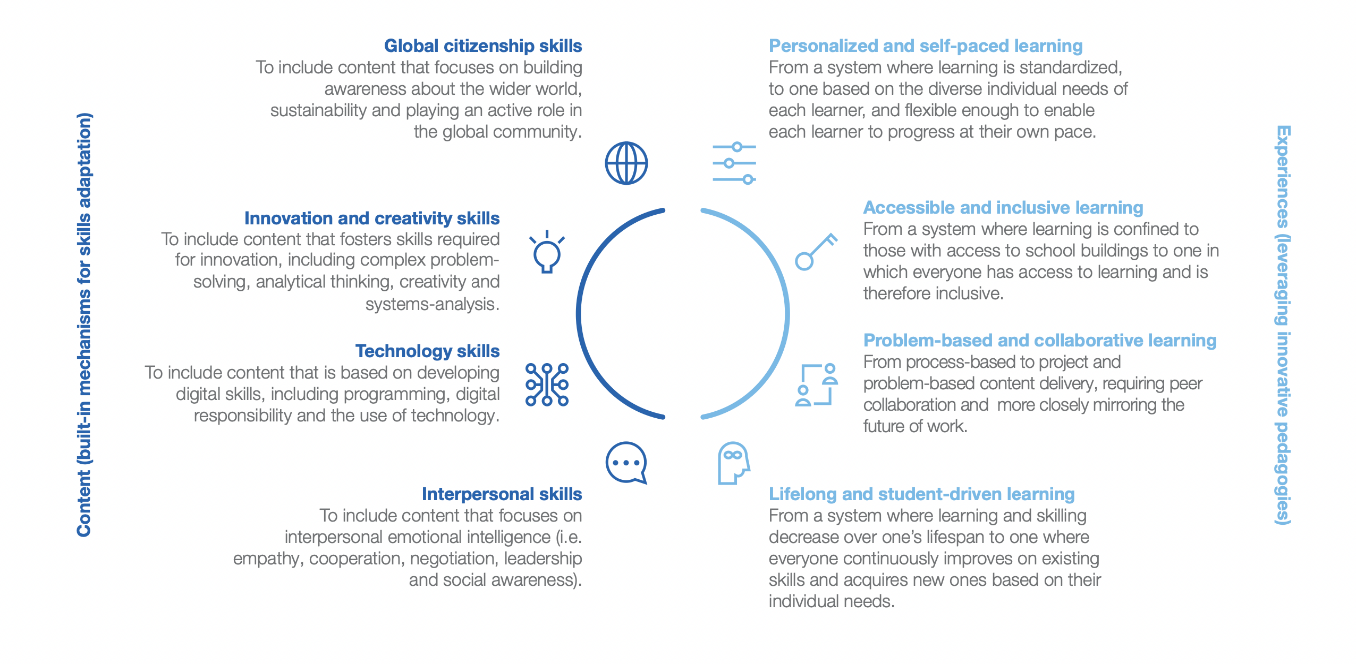
The World Economic Forum education 4.0 framework. Ref: World Economic Forum/Schools of the Future report
With its innovative approaches to student engagement, enhanced learning outcomes, and increased accessibility and equity in education, AI is revolutionizing the global educational landscape. AI has the ability to foster in students a sense of curiosity, critical thinking, and creativity through personalized learning experiences. Modern technology can help teachers overcome resource limitations, close quality gaps, and provide students with a more engaging learning environment.
Customized and Efficient Education System
The potential of artificial intelligence to deliver individualized learning experiences is among its most important contributions. AI systems examine how students learn and modify the curriculum to suit each student's needs. This guarantees that learners can advance at their own pace, better understanding difficult ideas with their individual learning preferences. This personalized approach fosters a more inclusive learning environment by not only pushing the advanced learners but also assisting struggling students in catching up. AI-powered interactive lessons can also improve the comprehension and interest level of the content. Through various games, simulations, and virtual tutors, students can delve deeper and examine topics from a variety of perspectives. AI tools, for example, can transform abstract scientific or mathematical ideas into interactive models, allowing students to explore and visualize concepts that would otherwise be intimidating in conventional classroom settings.
Advanced Teaching Methods
Artificial Intelligence provides teachers with additional tools to improve their teaching methods. AI allows teachers to concentrate more on teacher-student engagement by automating repetitive tasks like attendance tracking, grading, and even creating customized assignments. AI-powered tools can help instructors plan lessons as AI systems can gauge students' levels of engagement, confusion, or frustration by examining their facial expressions and emotions throughout lessons. With the help of this real-time feedback, teachers can modify their lesson plans as needed to keep students interested and ensure that concepts are explained clearly. Both teachers and students can gain from more dynamic and responsive teaching methods which are data-based.
Case Study: China's Squirrel AI
One of the best examples of how AI is transforming education is Squirrel AI, a Chinese company that uses AI to power education. By levelling the playing field for students from different backgrounds and addressing the lack of individualised attention in traditional classrooms, the platform benefits students. One noteworthy success story involved a 13-year-old student who, in just one semester, increased their math test scores from 50% to 62.5% with the help of Squirrel AI's tutoring support. Two years later, the student achieved 85% on their final middle school exams. AI systems that teach Chinese characters using computer vision and speech synthesis are beneficial even for first graders.
Challenges to the Education Sector of Pakistan:
Pakistan, with about 23 million children out of school, has various issues with education, such as a lack of trained teachers, a high student dropout rate, poor infrastructure, and a widening digital divide. According to UNESCO, to meet its educational targets by 2030, Pakistan must significantly increase its no of teachers. The current educational system is under tremendous strain as a result of this shortage. The problem has been worsened by the administrative load that current teachers bear, which leaves little time for individualized student engagement.
Moreover, a major obstacle to effectively utilizing AI in Pakistan is the lack of digital skills in the country. AI has the potential to revolutionize education, but a lot of people lack even the most basic digital literacy. AI may be able to provide the creative solutions needed to address these problems.
How AI Can Revolutionize the Education System?
In developing countries like Pakistan, AI has the potential to provide high-quality, scalable, and reasonably priced learning resources, thereby addressing major issues in the education system. Artificial Intelligence can fill in the gaps left by a lack of infrastructure, shortage of teachers, and limited resources by providing innovative learning experiences. By using AI even those who live in far-flung areas like Balochistan can get a top-notch education that meets all international standards. This strategy encourages greater educational equity among all the provinces of Pakistan while assisting in the mitigation of disparities. By providing adaptable, AI-powered learning environment, people can meet their professional or academic objectives whenever it's most convenient for them. This helps students take advantage of more opportunities and contributes to the development of society as a whole by producing a workforce that is more knowledgeable and competitive in the global economy.
AI-Driven Initiatives Taken in Pakistan
The COVID-19 pandemic and other recent international events have accelerated the use of AI in the education sector. Because of lockdowns and other disruptions during the pandemic, educational institutions around the world—including those in Pakistan—faced difficulties which they never heard of. This sped up the transition to digital education, with AI emerging as a key tool for improving and transforming the educational environment.
A noteworthy initiative is "The City School Group," which collaborated with "Century" to ensure that instruction continued unhindered throughout the lockdown. By utilizing artificial intelligence, this partnership was able to minimise the disruptions caused by the pandemic by guaranteeing that students always had access to educational resources. For students, this meant information which is always available, and for teachers, it meant AI tools that made lecture preparation easier and content delivery clearer. Students' academic performance improved as a result of this initiative, which also raised the quality of education.
Apart from its immediate use in the pandemic, several eminent universities in Pakistan are proactively integrating artificial intelligence into their academic programs to make students capable of proficiencies pertinent to the contemporary digital landscape. University of Engineering and Technology (UET) lahore, for example, has launched a master's program in artificial intelligence. Similarly, the National University of Sciences & Technology (NUST) trains students for professions in cutting-edge technology by providing undergraduate and graduate degrees in machine learning and natural language processing.
AI-related courses and programs have also been introduced by other organisations, including the Commission on Science and Technology for Sustainable Development in the South (COMSATS) and the Lahore University of Management Sciences (LUMS). These programs seek to give students the know-how and abilities needed to prosper in a quickly changing technological environment, highlighting AI's revolutionary influence on Pakistani education.
Possible Barriers to the Implementation
One of the several major obstacles is data privacy and cybersecurity since security lapses could compromise the system as a whole, necessitating the implementation of strong security protocols. For example, as per recent reports data breaches in Pakistan have risen by 35% over the past year, highlighting the need for enhanced cybersecurity measures. Firewall was made to protect that but instead, it restricts access to worldwide AI tools and resources and impedes the use and efficacy of AI in education.
Low literacy rates are also problematic, especially in rural areas. Pakistan has a 60% literacy rate, with notable differences between the country's urban and rural areas. The situation is even worse in rural areas, where educational opportunities are scarcer. Another issue is resistance to change, as many educational institutions and teachers are hesitant to implement new technologies out of concern for their jobs and traditional teaching methods.
Economic constraints are also a major issue as an AI system’s implementation and maintenance can be prohibitively expensive, particularly for educational institutions with limited funding. Pakistan spends less than 2% of its GDP on education, which reduces the amount of funds available for the development and upkeep of AI systems. It's possible that current AI tools don't fully satisfy regional demands or aren't designed for a variety of educational environments. Inadequate knowledge and instruction among teachers, policymakers, and students impede efficient utilization even more. For example, a recent UNESCO report states that just 22% of Pakistani teachers have received formal training in digital literacy – now imagine the situation.
About 43% of rural areas lack dependable internet access, making infrastructure constraints like poor internet connectivity a problem. Another layer of complexity is added by institutional and political resistance, which includes elite capture and a lack of political will.
Conclusion
A complex landscape of opportunities and challenges surrounds the integration of artificial intelligence into Pakistan's educational system. Although AI has the potential to revolutionize education by providing tailored learning experiences, improving teacher effectiveness, and increasing access to high-quality education, there are a number of important obstacles that need to be overcome. Critical barriers to the successful application of AI include low literacy rates, stringent firewall laws, and enduring concerns about cybersecurity and data privacy. Further impeding progress are economic limitations, insufficient infrastructure, and resistance to technological change.
Given the increasing number of data breaches and Pakistan's limited internet freedom, it is clear that strong cybersecurity measures are required. In a similar vein, addressing the differences in education between urban and rural areas, enhancing teachers' technological proficiency, and guaranteeing free access. To overcome these obstacles, financial commitments, focused training, and infrastructure advancements will be essential.
Despite these challenges, AI has enormous potential to transform Pakistan’s education system. When used carefully, AI can improve learning outcomes, close educational gaps, and advance the long-term development of the country.
